What Design for Manufacturability Revies Cover
Wall Thickness and Material Flow
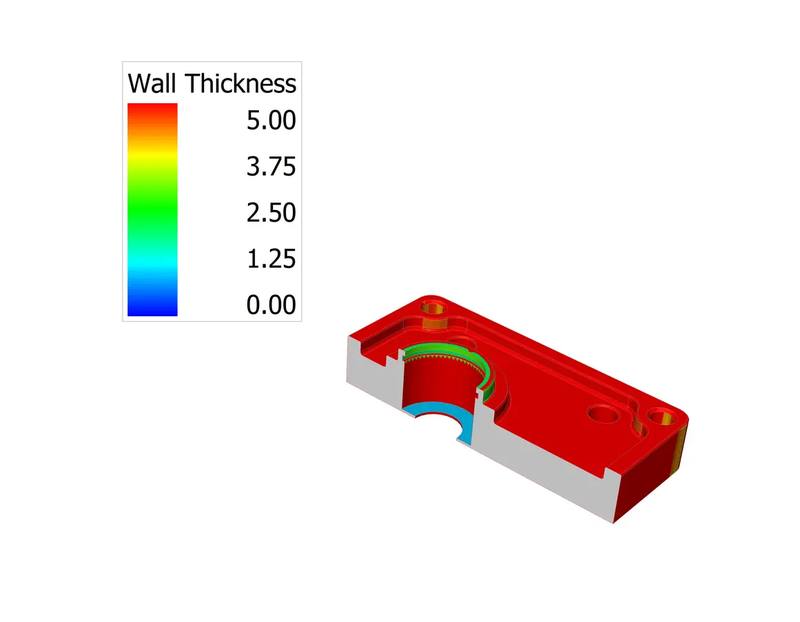
Uniform wall thickness is intrinsic to molded components. When a thick section is too close to a thin one, the cooling rates vary. This often shows up as sink on a cosmetic surface or as stress locked inside a part. Thogus maps wall sections and may recommend coring or gradual transitions to prevent issues like these.
Draft Angels
Parts need to release cleanly with run after run. Without enough draft, ejection drags the part across the steel, leaving scuffs or even cracking it. So, how much draft is enough? The answer depends on
Gate Location and Parting Line
Gate placement affects knit line location, fill balance, and shrink behavior. Because the gate and parting line are closely connected, Thogus evaluates them together during the design for injection molding review to protect cosmetic surfaces and position gate vestige in an inconspicuous area.
Undercuts and Side Actions
While snap fits and side holes add function, they also add complexity to an injection mold. Every undercut may require a slide or a lifter, and each moving part increases both the tooling cost and the maintenance load. Our team often finds a way to reshape a feature, so a simple pass-through core or bypass shutoff can form it. If an action is truly necessary, we design it to perform reliably over the entire lifecycle of the program.
Ribs and Bosses
Properly sized ribs add stiffness without adding bulk, but excessive thickness can cause sink marks on the opposite surface. Thogus engineers generally size ribs at 50 to 60 percent of the nominal wall thickness. Bosses follow similar design principles: they are cored out and reinforced with gussets to maintain strength without creating unnecessarily thick sections.
Resin Selection
Material selection is one of the most important parts of design for injection molding reviews, as resin choice affects part performance, cost, manufacturability, and dimensional stability. Glass-filled nylon, for example, behaves very differently in a tool than polypropylene does, and shrink rates vary widely between grades. If you haven’t decided on any material, we can help. With our material expertise, we can help you balance mechanical requirements against cost and processability.
Tolerances
Some tolerances are essential, while others are specified out of habit or caution. Thogus reviews critical dimensions to identify those that may be difficult to manufacture consistently. We then discuss practical alternatives, so the design reflects the part’s actual requirements.
Why Partner with Thogus for DFM Solutions
- Molding since 1950: Our design for injection molding services are backed by more than seven decades of experience.
- Feedback by the people who run the molds: Our recommendations come from our toolmakers and process engineers who know exactly what causes press issues.
- 35+ electric and hydraulic injection molding machines: With tonnage ranging from 35 and 720 tons, we can match your part to the right equipment, so our advice reflects real production conditions.
- ISO 9001:2015 without design certification: Every program follows documented, repeatable quality procedures.
- Honest guidance: If a simpler approach will serve you better than the one you started with, we will tell you.
Request a Design for Injection Molding Review
Have a part in development? Reach out to the engineers at Thogus for thorough, honest design for manufacturability (DFM) solutions. The insights you gain could save weeks on your project timeline and prevent a plethora of downstream production issues. Also check out our full line of custom injection molding services, secondary operations, and the industries we specialize in.
FAQs About Design for Manufacturability
When should I request a DFM review?
The ideal time to request a design for injection molding review is once your 3D model has its key features in place, before tooling is quoted.
Will you change my design without my approval?
Never. All recommendations we make are suggestions. You decide which changes to adopt, and nothing moves into tooling until you give the green light.
What are the most common design problems you see?
Common design issues include uneven wall thickness, insufficient draft, and undercuts that can often be resolved with minor geometry changes.